Used Car Buying at Auction vs Dealer: How Hidden Fees and Title Checks Change the Real Cost
When you compare used car buying at auction vs dealer, the sticker price is rarely the price you pay. Both routes add hidden fees — buyer premiums, documentation charges, reconditioning, lot fees — and the total can land far above the advertised number. Before you weigh either option, work out what you will actually spend.
Comparing the two means calculating the “real cost.” That figure combines the purchase price, every add-on fee, and the outcome of a thorough title check. A clean title keeps a car easy to register and resell. A salvage, rebuilt, or lien-encumbered title can turn a bargain into a burden. Dealer costs tend to surface late in the negotiation, while auctions publish a fee schedule and then apply it line by line.
The rest of this article covers how auction fees are structured, how dealership pricing works, how to run a reliable title check, and how to build a worksheet for the real total. To see how these numbers behave on actual inventory, browse used cars under $10,000.
Hidden Fees at Auto Auctions
An auction looks simple: you bid, you win, you pay the number on your paddle. The winning bid is rarely the final figure. Fees stack on top and can add hundreds or even thousands of dollars before the car is yours. These are the ones buyers most often miss.
- Buyer premiums — a commission on the hammer price, usually 5% to 15%. It is added to your bid and is almost never negotiable.
- Bidder registration fees — a flat charge just to participate. Some auctions refund it if you buy a vehicle; others keep it either way.
- Internet or proxy bidding surcharges — charged when you bid remotely or set an automated proxy bid instead of attending in person.
- Transportation and storage fees — moving the vehicle off-site, plus daily storage if you cannot collect it within a short grace period.
- Post-sale documentation or gate fees — administrative charges for title paperwork, transfer processing, and leaving the lot with your purchase.
Stacked on the winning bid, these charges can leave you paying far more than you budgeted. Compare against retail listings first — for example, these Autotrader used car listings — to judge whether the auction is genuinely cheaper. Reading the full fee schedule before you raise your paddle is the only reliable way to know your real price.
Hidden Fees at Dealerships
On a dealer lot, the sticker price is rarely the price you sign. Add-ons appear late in the deal, once the conversation has shifted to monthly payments rather than line items. Each one pushes the real cost of used cars past the advertised figure.
Documentation fees are the most common. Often called doc fees, they cover contract preparation and title filing, typically run from around $85 to more than $900 depending on the state, and are seldom negotiable.
Dealer preparation or reconditioning fees pay for cleaning, inspections, and minor repairs. That work is often finished before the vehicle reaches the lot, so buyers may pay for it twice.
Advertising or market adjustment fees appear when demand is strong. They are largely markup, and on popular models they can add thousands to the out-the-door number.
Financing and insurance add-ons include gap insurance, credit life coverage, and paint or fabric protection. Because they are folded into the loan, you also pay interest on them.
Extended warranty pitches arrive last. A finance manager may present a service contract as essential protection, but the price is negotiable and the coverage frequently overlaps with what you already have.
Auction fees differ from dealer add-ons in both size and predictability. Auction charges are published up front: buyer fees, internet bidding fees, and title fees appear on the sale sheet or website, usually totaling a few hundred dollars. Dealer add-ons are variable, loosely disclosed, and occasionally invented at the desk.
Dealer pricing is opaque, so research before you go. Cross-check asking prices against CarMax used car listings and confirm market values with an Edmunds used car value lookup. A baseline lets you separate fair charges from inflated ones.
Calculating the Real Cost Before You Commit
When shoppers compare used car buying at auction vs dealer, the advertised number tends to steal the spotlight. Yet that figure — a dealer’s sticker or an auction’s winning bid — is only the opening move. Judging the real cost of used cars means adding up every dollar you will actually spend.
Four layers make up the total.
1. The Acquisition Price
Your winning bid or negotiated sticker price. It is the easiest part to find and the least reliable on its own.
2. Every Fee
Dealers layer on documentation, prep, and sometimes advertising charges. Auctions add buyer’s premiums, gate or registration fees, and online bidding surcharges. Read the fine print and list each one; fees that look tiny can add hundreds to your total.
3. Expected Repairs
Auctions usually sell vehicles as-is, so budget for immediate maintenance: tires, brakes, fluids, belts, and any obvious mechanical work. A pre-purchase inspection is worth the cost because it turns guesswork into a real estimate.
4. Title Resolution Costs
Missing, lost, or branded titles can demand extra paperwork, bond fees, or legal legwork before the car is legally yours to register and insure.
Organize the math like this:
| Cost Component | How to Estimate It |
|---|---|
| Acquisition price | Winning bid or negotiated sticker price |
| Fees | Buyer’s premium, doc, prep, and registration charges listed in the terms |
| Expected repairs | Inspection findings plus a cushion for wear items |
| Title resolution | Quote paperwork, bond, and registration costs |
| Grand total | Sum of every line above |
Once every line is filled in, add it up. The final number, not the advertised one, is what you are really paying. Two listings with the same sticker price can land far apart after fees, repairs, and title work, especially once you weigh an auction’s as-is reality against a dealer’s occasional reconditioning. The total, not the headline price, should drive your decision.
Compare real listings side by side as you narrow the field. Explore budget-friendly options under $10,000 or browse vehicles for sale near you to see how prices and terms vary, then run each candidate through your cost model before you commit.
Total Real Cost of a Used Car by Buying Route
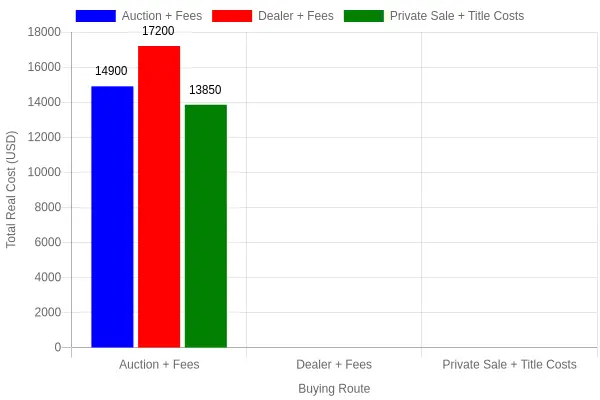
The chart below compares the total real cost — base price plus every fee, tax, and title cost — for one representative used car bought through three common routes.
Chart title: Total Real Cost of a Used Car by Buying Route
Y-axis: Total Real Cost (USD)
X-axis: Buying Route
Data points:
| Buying Route | Total Real Cost (USD) |
|---|---|
| Auction + Fees | 14,900 |
| Dealer + Fees | 17,200 |
| Private Sale + Title Costs | 13,850 |
The dealer route costs roughly $3,350 more than a private sale on the same vehicle, a gap created mostly by documentation fees, dealer prep, and inflated add-ons. The auction sits in the middle: its lower hammer price gets eaten up by buyer premiums, transport, and reconditioning.
What the bars actually tell you
- Private sale — lowest total, but the title-transfer paperwork is yours.
- Auction — cheap to enter, expensive to exit once fees stack up.
- Dealer — highest total; convenience carries the steepest fee premium.
Before you sign anything, benchmark the car’s fair market value so you can tell which fees are legitimate and which are padding. Compare listings and pricing benchmarks such as Edmunds used car value to keep the dealer honest. If you hunt for budget-friendly inventory directly, browsing used cars under $10,000 shows how far the list price can swing once fees enter the picture.
Why Title Checks Change the Real Cost
A car’s title records who owns it and whether that ownership is clean. When it carries a brand such as salvage, rebuilt, flooded, or lien-holding, the real cost of the car changes long before you reach the registry office.
What a branded title does to value
A salvage title typically cuts resale value by 20% to 40%, and a rebuilt title by 10% to 25%. Flooded titles are worse, because water damage hides in wiring and electronics that surface months later. A lien-holding title means someone else still has a legal claim, so ownership cannot transfer until that debt clears.
| Title Type | Typical Value Impact | Insurability | Transfer Risk |
|---|---|---|---|
| Clean | None | Full coverage | Low |
| Salvage | 20-40% lower | Limited or refused | High |
| Rebuilt | 10-25% lower | Possible, higher premiums | Medium |
| Flooded | 30-50% lower | Often refused | High |
| Lien-holding | Varies | Depends | Very high until cleared |
Insurability and transferability
Many insurers limit coverage or refuse comprehensive policies on salvage and flooded vehicles. Rebuilt titles are easier to insure but usually cost more. A title that cannot transfer cleanly leaves you holding a car you cannot legally register, resell, or trade in.
Skipping the check: auction versus dealer
At auction, buyers often win vehicles “as-is,” with no title guarantee beyond a quick glance at paperwork. If the title is branded and undisclosed, the loss is yours. At a licensed dealer, the seller usually has a legal duty to disclose title status, so your risk is lower but never zero.
Unresolved title problems turn into hidden fees fast: re-titling charges, surety bond fees, repair bills, and legal costs. They can erase any bargain you thought you found. Running a title check before money changes hands is the cheapest protection you can buy, whether you plan to sell your car for cash later or buy from a used car dealer directly.
A Practical Checklist for Comparing Auction and Dealer Purchases
Run both an auction lot and a dealer lot through the same steps before you commit, so you compare real costs instead of sticker prices.
- Request an itemized fee sheet in writing. Ask for a full breakdown that lists buyer premiums, administrative charges, dealer documentation fees, taxes, and every add-on. A refusal to provide this in writing is a red flag.
- Run a title check before bidding. Pull the vehicle history using the VIN to confirm it is not branded as salvage, flood, or rebuilt, since auction listings often disclose far less than a dealer will.
- Verify lien status. Confirm the title is clear and free of any outstanding loan or lien; an unpaid lien can block your registration for months.
- Budget for repairs. Set aside a realistic repair fund and, whenever possible, refresh your current market value estimates so you know what the car is truly worth after fixes.
- Compare out-the-door prices. Add every fee to the sale price for both the auction and the dealer, then compare the final totals side by side.
- Confirm transfer and registration costs. Check your state’s title transfer, plate, and registration charges; they vary widely and are easy to overlook.
- Set a walk-away number. Decide your maximum all-in budget in advance and stick to it when the bidding or negotiation heats up.
- Document everything. Keep copies of the fee sheet, title report, and receipts so you can prove the numbers if a dispute arises later.
Work through these steps every time, and the cheaper option usually becomes obvious before you sign or bid.